
What AI agents are, and where your business might already have one
A new era of AI agents has landed, and the news is moving fast. In the space of a few weeks OpenAI, xAI, Meta and Google have all launched or announced their own, and Microsoft's Copilot now has one too. If you've felt you can't keep up, you're in good company.
This is the plain English version I'd give any leader: what an agent is, the types worth knowing, and where you might already have one without calling it that.
What an AI agent is
The AI most of us started with waits for you. You ask a question, it answers, and nothing happens until you ask again.
An agent is given a job and goes and does it. It works through the steps itself, uses the apps you've connected, and keeps going while your laptop is shut. It comes back with the work done, or with a question for you.
What's arrived
Five have taken most of the attention. Here's how they compare.
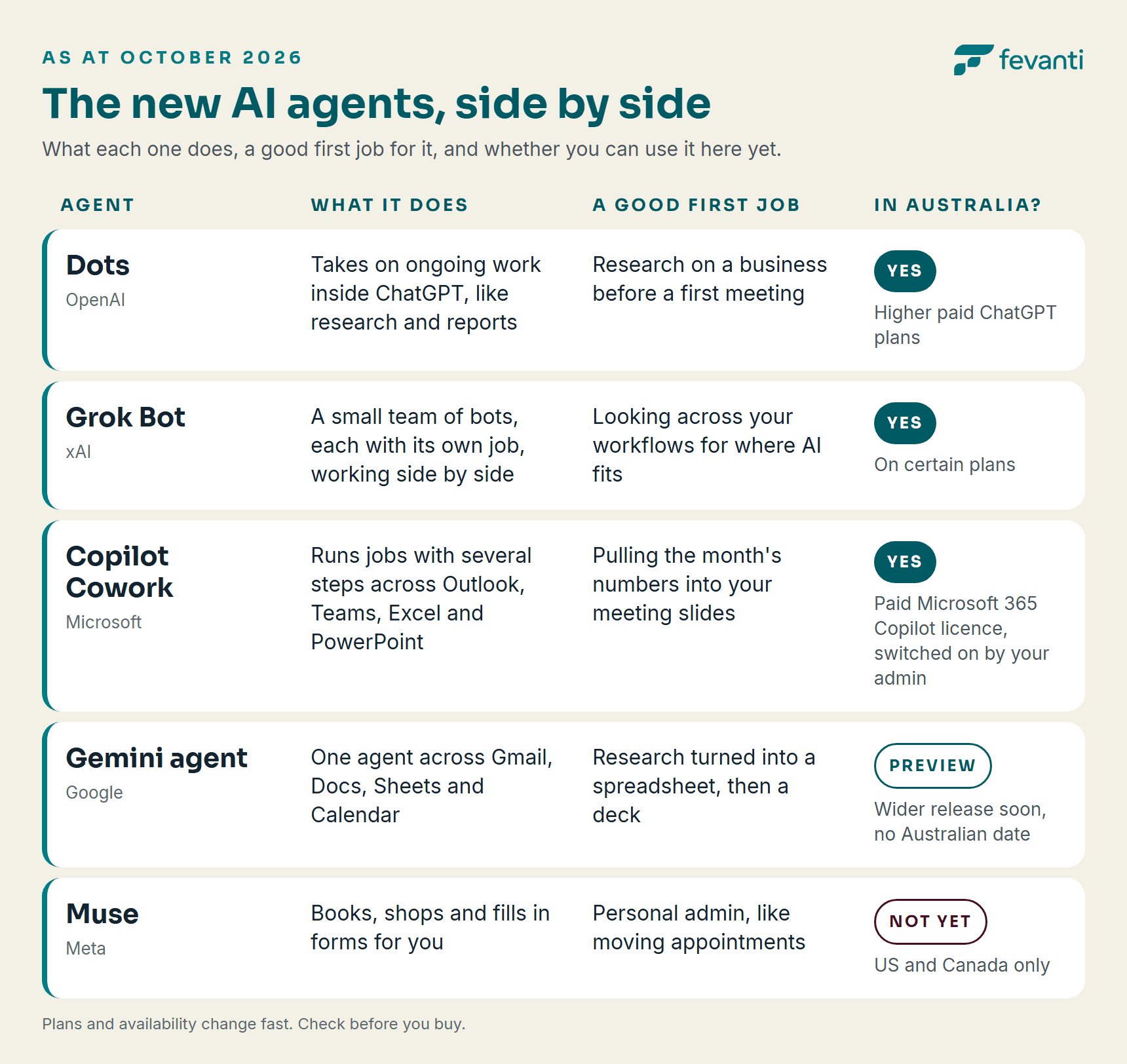
If your business runs on Microsoft 365, Copilot Cowork is worth a look first, because it sits inside software you may already pay for. Gemini agent is in private preview, with a wider release promised soon on select Google Workspace plans, but no price, release date or Australian date yet. Meta's Muse is only in the US and Canada so far, and I'll be watching for it here.
The five types worth knowing
The new launches are one kind of agent. There are a few others, and your business may already have one or two.
Agents inside software you already pay for. Microsoft's Copilot, Salesforce and HubSpot have built them into their products, and Google's Gemini agent is coming to Workspace. They only work inside that product, which makes them a sensible place to start. Think of an agent in your CRM that drafts a follow up after each sales call.
Agents that talk to your customers. The chat on your website, or a voice that answers the phone after hours. A good one answers common questions about delivery times and passes anything unusual to your team.
Background workers, like Dots and Grok Bot. You hand them ongoing work, such as a weekly summary of what your competitors changed on their websites.
Personal agents. They act for one person, booking, shopping and filling in forms on their behalf. Meta's Muse is the best known, and it hasn't reached Australia yet.
Agents you build yourself. Set up to do one job on a schedule, using tools like ChatGPT or Claude. A morning brief from the newsletters you never get through is a good first one.
Where you might already have one
Before trying anything new, it's worth a look at what's already switched on. I'd ask whoever looks after your systems three questions:
Has our CRM, email platform or accounting software added AI agents in the last year, and are they turned on?
Does our website chat or phone system use AI to answer customers?
Has anyone on the team connected a personal AI assistant to their work email or calendar?
The third question matters most. Several of these agents have free versions, and connecting one to a work email is a decision about your business data, whether or not anyone made it on purpose.
Your customers will have them too
Most of the excitement is about what agents will do for you. Your customers have the same agents. Before they speak to anyone on your team, an agent may have read your website, your reviews and your LinkedIn page and handed them a summary. Once it's released, Google's Gemini agent can be given its own work email address and calendar, so some of the meeting requests your team handles will come from an agent rather than the person behind it.
It's worth asking Dots, Gemini or ChatGPT to research your business the way a customer would, and reading what comes back. If your website is out of date or your services are hard to work out, the summary your customer reads will be too.
How I'm using them
I've built some agents of my own for Fevanti. One reads the AI newsletters I never get through and has a brief in my inbox at 6am. I've also got Grok Bot looking across different areas of the business and my workflows, working out where it can fit into how I run Fevanti today.
I'm encouraging every leader I work with to try one. Start with a single job that eats your time each week, and see what it gives you back.
Find your AI Altitude to see where you stand across yourself, your business and your team.


